
For compliance officers and IT teams managing FATCA reporting, there are few things more frustrating than seeing a "Transmission Deleted" alert on the IRS International Data Exchange Service (IDES) portal.
Unlike standard web portals, IDES does not simply accept a file and process it. It runs an immediate, aggressive series of cryptographic, compression, and metadata checks. If your data packet deviates from the IRS's strict technical standards by even a single byte, the transmission is instantly rejected before the underlying tax data is even reviewed.
As we approach the final filing cycles before the 2027 IRIS transition, tax authorities are less forgiving of technical anomalies. Here is a breakdown of the most common IDES alert codes, why your manual data packaging is failing, and how to resolve these fatal errors.
1. RC003: Failed Encryption Check
The RC003 (Failed encryption check in IDES) alert is one of the most common—and most difficult to manually troubleshoot—errors in FATCA reporting.
The IRS mandates that all XML payloads be encrypted using AES-256 cryptography. To do this, you must generate a single-use AES key to lock the XML file, and then encrypt that AES key using the IRS's public RSA key.
An RC003 error typically means your cryptographic process broke down in one of the following ways:
-
Key Mismatch: The AES key provided in your transmission package was not the exact same AES key used to actually encrypt the XML payload.
-
Wrong IRS Public Key: You encrypted the AES key using an outdated or invalid IRS public RSA key, preventing the IDES system from decrypting your payload.
-
Corrupted Payload: The file became corrupted after it was compressed but before the AES encryption step was finalized.
2. RC004: Failed FATCA Metadata Schema Check
Before the IDES system even attempts to decrypt your payload, it reads your Metadata file. If you receive an RC004 (Failed FATCA Metadata schema check), your Metadata.xml file is structurally flawed.
Common metadata failures include:
-
GIIN Mismatches (RC012 / RC008): The Sender Global Intermediary Identification Number (GIIN) in the metadata does not perfectly match the GIIN inside the XML payload, or the GIIN is simply invalid.
-
File Format Inconsistencies: The file format specified in your metadata (e.g., XML) does not match the actual file type inside the encrypted package.
-
MessageRefId Duplication: The
MessageRefIdfield must be a completely unique alphanumeric string for every single transmission. If you reuse aMessageRefIdfrom a previous submission or test file, the IDES portal will reject it.
3. RC025 & RC027: Zip Package and Compression Failures
The IRS requires a highly specific sequence for packaging your data. You cannot simply drop your XML file and metadata into a standard folder and right-click to "compress."
If you receive an RC025 (Invalid zip package file) or RC027 (Zip package contains a folder), you have likely violated the IDES packaging rules:
-
No Folders Allowed: Your final ZIP archive must contain only the individual encrypted payload, the encrypted AES key, and the metadata file. If these files are housed inside a sub-folder within the ZIP archive, IDES will reject the entire transmission.
-
Unsupported Algorithms: The XML file must be compressed before it is encrypted. If you use an unsupported compression tool or algorithm, the IRS decoding mechanism will fail to unpack it.
The Danger of Manual File Packaging
If your team is trying to manually stitch together digital signatures, AES ciphers, public RSA keys, and metadata schemas, you are operating with an incredibly high margin for error.
Generating a FATCA or CRS submission is not an advisory task; it is a software engineering task. The exact sequence of operations—Generate XML ➔ Digitally Sign ➔ Compress ➔ AES Encrypt Payload ➔ RSA Encrypt Key ➔ Generate Metadata ➔ Zip Archive—must be executed flawlessly via code, not by human hands moving files around a desktop.
Eliminate Technical Friction
This strict demand for cryptographic perfection is why modern financial institutions are moving away from manual filing and full-service agents who lack deep data architecture expertise.
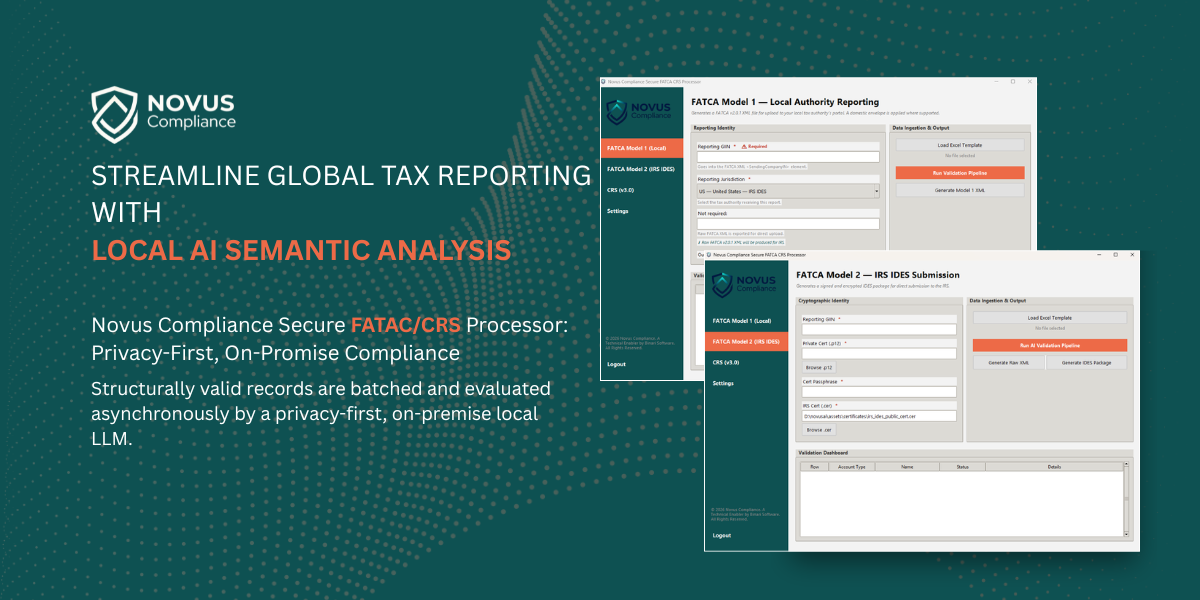
As a dedicated technical enabler, Novus Compliance removes the IDES portal guesswork. We do not provide tax advice; our platform exists strictly to solve this exact technical bottleneck.
You finalize your tax data, and our software programmatically generates the flawless XML schema. We automatically handle the digital signatures, the IDES-approved compression, the AES-256 encryption, and the metadata generation. The result is a structurally perfect, highly secure .zip file ready for direct upload to IDES—completely eliminating RC alert codes and compliance headaches.