
Every year, thousands of financial institutions, asset managers, funds, and custodian banks face an administrative reckoning: annual reporting under the Foreign Account Tax Compliance Act (FATCA) and the Common Reporting Standard (CRS).
What sounds like a unified global regulatory framework is, in operational reality, an extraordinarily fragmented technological minefield. Financial institutions must collect customer self-certifications, conduct exhaustive due diligence, review transaction balances, and translate hundreds of thousands of raw accounting entries into complex, schema-valid XML payloads.
Making matters worse, no two countries accept data in the exact same format. While the OECD and the US Internal Revenue Service (IRS) design global standards, individual domestic tax authorities modify, wrap, or completely replace those standards with proprietary local vocabularies. Compliance officers and IT teams find themselves trapped between conflicting deadlines, obtuse validation errors, legacy tax authority upload portals, and severe financial penalties for non-compliance.
This is where next-generation, AI-driven compliance automation reshapes the industry. By deploying a hybrid architecture—combining high-speed deterministic validation, jurisdiction-aware XML schema engines, and privacy-preserving, on-premise Artificial Intelligence—modern compliance platforms eliminate manual reporting friction entirely.
1. The Core Regulatory Frameworks: Untangling FATCA and CRS
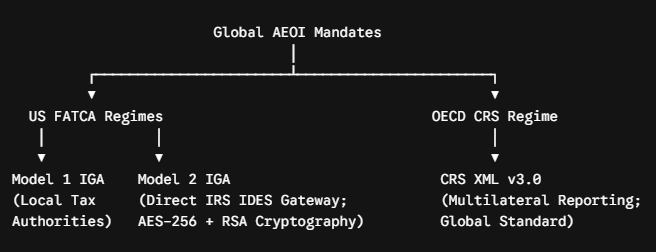
To understand why automated compliance software is essential, one must look at the three foundational pillars governing global automatic exchange of information (AEOI):
FATCA Model 1 Intergovernmental Agreements (IGA)
Under a Model 1 IGA, the financial institution’s home government signs a bilateral agreement with the United States Treasury. Financial institutions located in Model 1 jurisdictions do not report directly to the IRS. Instead, they report their foreign financial account data directly to their domestic tax authority (such as the CRA in Canada, the CBDT in India, or HMRC in the United Kingdom). That domestic authority then aggregates the data and transmits it to the IRS on the government's behalf.
The primary engineering challenge of Model 1 reporting is that each local government implements its own intake rules, transmission protocols, and XML schemas.
FATCA Model 2 IGA (v2.0.1) & Direct Reporting
Under a Model 2 IGA—or for direct non-IGA participating Foreign Financial Institutions (FFIs)—the institution reports directly to the IRS. This reporting requires strict conformity with the standard FATCA XML Schema v2.0.1.
The barrier to entry for Model 2 reporting is not just generating the XML file; it is the cryptographic transmission pipeline. Data sent to the IRS must pass through the International Data Exchange Service (IDES) gateway. Submissions require:
-
XML Digital Signatures: Signing the payload with the filer’s private key using their validated
.p12certificate. -
Envelope Encryption: Encrypting the payload with AES-256 CBC using an ephemeral symmetric key.
-
Key Encapsulation: Encrypting that symmetric AES key with the IRS’s public RSA certificate (
.cer). -
Structured Packaging: Compressing the encrypted payload, metadata file, and encrypted key into a strict IDES archive.
Manually orchestrating certificates, digital signatures, and AES/RSA cipher suites in a spreadsheet-driven workflow is slow and prone to corruption.
The Common Reporting Standard: CRS XML v3.0
While FATCA targets US tax residents, CRS—spearheaded by the OECD—targets tax residency across more than 100 participating jurisdictions worldwide. Built on the CRS XML Schema v3.0, this standard requires institutions to identify every account holder's and controlling person's tax residency, local Taxpayer Identification Number (TIN), birth data, and comprehensive payment breakdowns (dividends, interest, gross proceeds, and other income).
Unlike FATCA, where account classification primarily centers on US Person vs. Foreign Entity status, CRS demands exhaustive multilateral due diligence. Reporting entities must simultaneously identify Active NFEs, Passive NFEs, Controlling Persons, and Investment Entities across dozens of reciprocal nations.
2. The Domestic Schema Maze: How Jurisdictions Fragment the Standard
The universal fallacy in regulatory technology is assuming that a standard OECD or IRS payload can simply be uploaded anywhere. In practice, domestic tax authorities enforce custom wrappers, alternative schemas, and bespoke data rules:
Country Tax Authority Submission Architecture Key Technical & Schema Rules 🇨🇦 Canada Canada Revenue Agency (CRA) CRA Domestic Envelope Requires<Submission> root with <T619> transmittal header, BN-15 account validation, and <PartXVIII> / <PartXIX> return structures.
🇮🇳 India
Central Board of Direct Taxes (CBDT)
Unified Domestic Form 61B
Single XML for dual FATCA/CRS; converts global enums into domestic codes (F1, C1, I), requires ITDREIN and strict 2-letter state codes.
🇩🇪 Germany
Bundeszentralamt für Steuern (BZSt)
Digitaler Posteingang (DIP) Wrapper
Encapsulates standard IRS FATCA payload inside mass-data <dip> header using ELSTER customer credentials.
🇱🇺 Luxembourg
Administration des Contributions Directes (ACD)
Nested AEOI Envelope
Wraps records in <AEOI_LUX> envelope, transforming core tags into <FATCA_LUX> namespace while referencing OECD base types.
🇦🇺 Australia
Australian Taxation Office (ATO)
ATO Bulk Data Exchange / SBR
Standard Business Reporting (SBR) intake validating against ATO-specific machine-readable reporting requirements and local ABN/TIN structures.
🇫🇷 France
Direction Générale des Finances Publiques (DGFiP)
TD/BIL AEOI Platform
Enforces strict national portal encapsulation, requiring domestic entity identifiers (SIREN/SIRET) alongside OECD payloads.
🇸🇬 Singapore
Inland Revenue Authority of Singapore (IRAS)
Raw Standard OECD / IRS
Developer-friendly direct ingestion of raw <ftc:FATCA_OECD> and <crs:CRS_OECD> payloads via myTax Portal without custom wrapping.
🇳🇱 Netherlands
Belastingdienst
FC Schema / Gegevensportaal
Uses domestic <FATCA_CRS> wrapper combining <MessageHeader> and <MessageBody> structures behind registered portal access.
🇮🇪 Ireland
Irish Revenue
Revenue Online Service (ROS)
Ingests pure IRS and OECD schemas; enforces strict technical limits (30MB / 20,000 records per file chunk) and exact MessageRefId formatting.
Canada — CRA
The Canada Revenue Agency refuses naked FATCA_OECD instances. Submissions must be packaged using the CRA's master electronic transmittal architecture. The document must open with a <Submission> root, followed immediately by a <T619> electronic transmittal block containing the transmitter’s 15-character Business Number (bn15), specific phone number formats, and contact metadata. Beneath the transmittal block, individual slips are encapsulated within <PartXVIII> for FATCA or <PartXIX> for CRS, terminating in an aggregated summary element.
India — CBDT
The Indian Income Tax Department takes a unified approach through Form 61B. Rather than requesting separate files for FATCA and CRS, the CBDT combines both regimes into a single, comprehensive submission. However, it entirely abandons standard OECD tags. Global entity designations like FATCA101 (Owner-Documented FFI) must be mapped to domestic enumerations like F1. CRS categorizations translate to C1 through C3. Legal entity constitutions require conversion into single-character codes (I for companies, B for partnerships), and addresses must strictly map to valid 2-letter Indian state codes (e.g., MH for Maharashtra, KA for Karnataka) or fall back to XX for foreign entities.
Germany — BZSt
The German Federal Central Tax Office accepts standard IRS FATCA v2.0.1 data, but will reject it if uploaded directly to their portal. Filer payloads must be encapsulated inside the Digitaler Posteingang (DIP) mass-data envelope (dip.xsd). The wrapper incorporates the filer's ELSTER identity, generation timestamps, and ticket metadata, packaging the pure IRS <FATCA_OECD> structure inside a <consignmentItem><data> body.
Luxembourg — ACD
Luxembourg’s tax authority requires files formatted under their AEOI_LUX v3.0 architecture. The application must generate the OECD payload, dynamically rename elements into the local urn:lu:etat:acd:fatca:v2.0 namespace, and nest the resulting <FATCA_LUX> structure inside a top-level <AEOI_LUX> envelope containing <AEOI_Depositor> and <AEOI_ReportingFI> compliance metadata.
Australia — ATO & France — DGFiP
In Australia, the ATO processes FATCA and CRS via its Standard Business Reporting (SBR) channels and Bulk Data Exchange frameworks. Filers must ensure reporting accounts map directly to Australian Business Numbers (ABNs) or domestic Tax File Numbers (TFNs) alongside global GIIN identifiers. Similarly, France’s DGFiP requires integration with the TD/BIL system, cross-verifying domestic SIREN/SIRET registry numbers before accepting foreign entity payloads.
Singapore — IRAS & Ireland — Revenue
In contrast, jurisdictions like Singapore (IRAS) and Ireland (Revenue) adopt a clean, standards-first approach. They ingest pure, unwrapped IRS and OECD XML instances directly through their online portals (myTax Portal and ROS, respectively). However, Ireland enforces strict physical constraints: files must not exceed 30MB or 20,000 records. Datasets exceeding these limits must be split into multiple linked files using strictly sequenced MessageRefId strings.
3. How the AI-Based App Works: The Architecture of Effortless Compliance
Solving this international mosaic requires rethinking compliance software. Legacy tools often rely on slow, monolithic desktop applications or brittle Excel macros that break when a tax authority updates an XSD schema.
Modern compliance engines deploy a decoupled, multi-tier pipeline designed for speed, resilience, and uncompromised privacy.
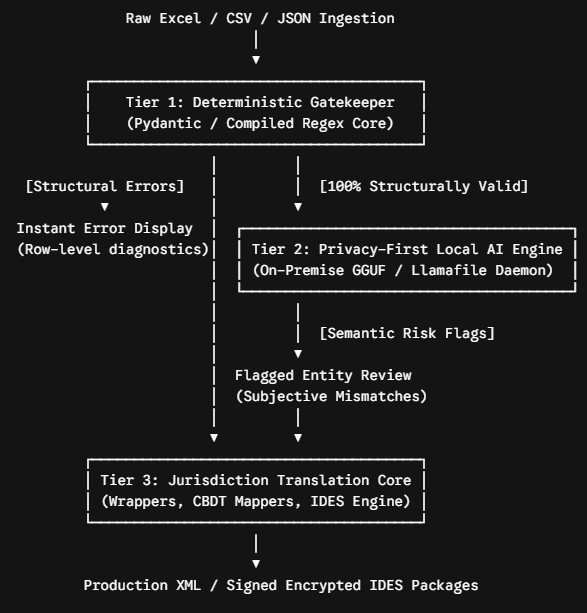
Tier 1: The Deterministic "Shift-Left" Gatekeeper
The first tier is rooted in software engineering's "shift-left" principle: validate data as early and as quickly as possible.
Instead of routing raw spreadsheets to an AI or waiting for a tax authority portal to reject a file, the platform processes incoming rows through compiled, deterministic validation schemas built on Pydantic.
-
Evaluates regular expressions for GIIN numbers (
^[A-NP-Z0-9]{6}\.[A-NP-Z0-9]{5}\.[A-Z]{2}\.\d{3}$), US TINs (^\d{9}$), and Canadian Business Numbers (^\d{9}[A-Z]{2}\d{4}$). -
Validates currency symbols against ISO 4217 lists and country designations against ISO 3166-1 alpha-2 standards.
-
Performs mathematical consistency checks (e.g., verifying that account payment sub-elements match gross proceeds and dividend summaries).
This layer processes 10,000 rows in less than two seconds, giving compliance officers immediate, row-by-row diagnostic feedback on typos, missing values, or invalid formats without consuming computational overhead.
Tier 2: The Privacy-First Local AI Semantic Engine
Deterministic rules catch syntax errors, but they cannot catch subtle human judgment failures. For example:
-
An account holder is listed as an "Individual," but the account name reads "Acme Industrial Holdings LLC".
-
An entity is classified as an "Active NFFE," but its income payment history consists of 98% passive dividends and interest, indicating a Passive NFE.
-
Address lines contain hidden jurisdiction indicators that contradict the declared country of tax residence.
Traditionally, catching these anomalies required manual, sample-based audits by senior compliance analysts. Cloud-based LLMs cannot be used here because sending unmasked banking records, balances, and taxpayer identification numbers across external third-party APIs violates GDPR, the Indian Digital Personal Data Protection (DPDP) Act, Swiss banking secrecy laws, and GLBA regulations.
The solution is an on-premise, localized AI engine. Operating via quantized models (using GGUF binaries and local execution daemons), the AI runs entirely in local RAM and GPU environments.
-
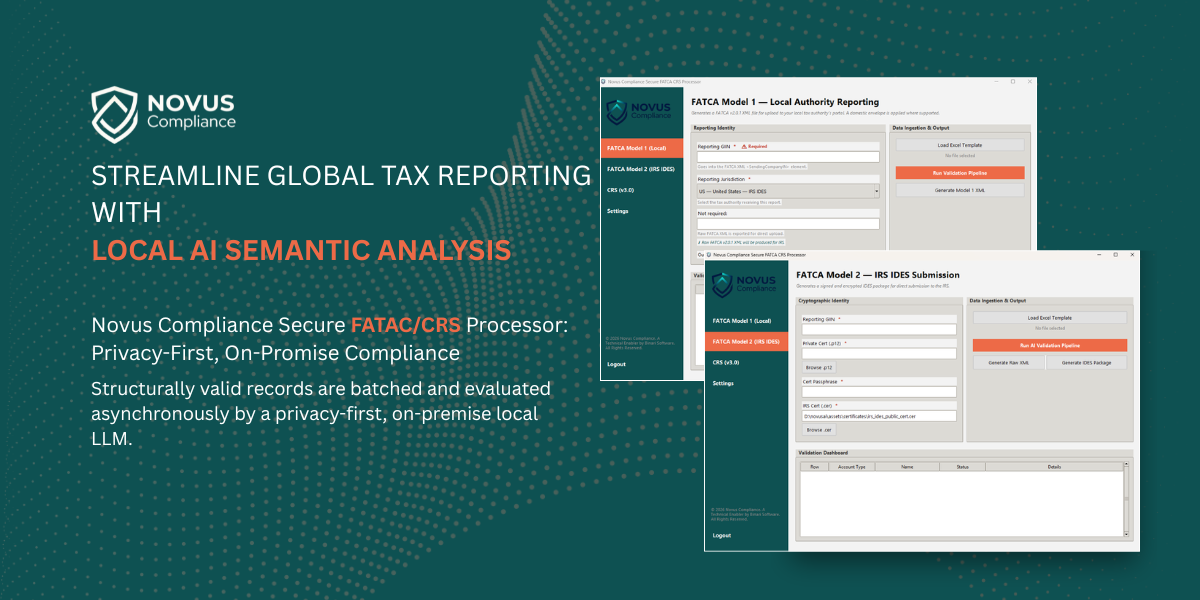
Asynchronous Batching: Validated records from Tier 1 are packaged into optimized JSON payloads (e.g., 50 records per batch) and dispatched concurrently across local inference threads.
-
Zero Cloud Leakage: No packets containing financial, personal, or tax data ever leave the institution's local perimeter.
-
Semantic Anomaly Detection: The local model focuses exclusively on subjective pattern matching, auditing account holder titles, entity names, and classification logic to flag suspicious registrations before the final payload is generated.
Tier 3: The Jurisdiction Translation & Cryptographic Packaging Core
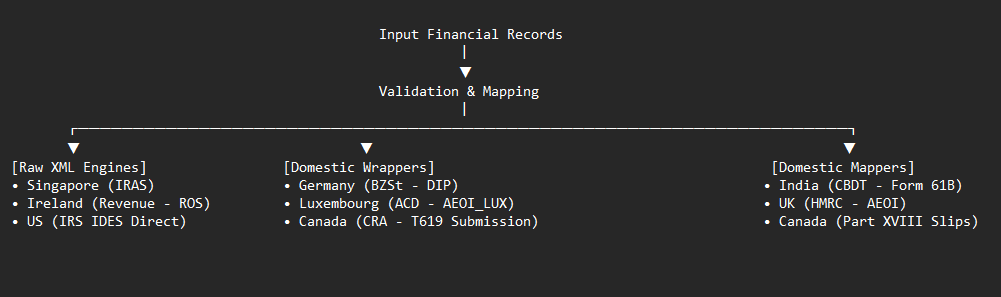
Once data passes both deterministic validation and AI auditing, the platform's orchestration layer routes the clean data to the appropriate output engine:
-
The Raw Engine: Directly renders pristine, unadulterated IRS FATCA v2.0.1 or OECD CRS v3.0 XML documents for jurisdictions like Singapore, Ireland, or New Zealand.
-
The Wrapper Registry: Dynamically constructs outer transmission envelopes—such as injecting the Canadian T619 header or wrapping records in the German BZSt DIP format—without mutating the core reporting models.
-
The Semantic Mappers: Completely translates underlying data points for jurisdictions like India, renaming every node, re-indexing identifiers, and applying strict local tax code enumerations.
-
The Cryptographic IDES Engine: For Model 2 filers, the application automatically accesses the institution's local keystore, manages certificate passphrases, generates SHA-256 digital signatures, wraps AES-256 session keys, and exports production-ready
.ziparchives configured for immediate IRS submission.
4. How It Makes Life Easy for Everyone
Automating this complex compliance pipeline delivers immediate operational dividends across every tier of an organization:
For Compliance Officers: From Firefighting to Strategic Oversight
Instead of spending weeks manually cross-referencing CSV columns, validating TIN lengths, and deciphering cryptic tax portal rejection notices, compliance teams gain a unified dashboard. They upload raw client data, view immediate red/green validation statuses, and review AI-flagged risk alerts with a single click. Compliance shifts from an exhausting administrative scramble into an orderly, push-button process.
For IT & Security Teams: Absolute Data Sovereignty
IT executives no longer need to worry about proprietary data leaks or regulatory breaches associated with cloud AI platforms. Because the entire processing and artificial intelligence stack executes locally on the workstation or enterprise server, data never crosses external network perimeters. Security policies, air-gapped requirements, and data sovereignty laws are preserved by design.
For Chief Financial Officers & Leadership: De-Risking Regulatory Penalties
Tax authority penalties for inaccurate or late AEOI reporting can escalate into millions of dollars, accompanied by reputational damage and the threat of revoked financial licenses. By enforcing end-to-end schema conformance and validating every file against official XSD definitions before submission, institutions ensure first-time acceptance across global portals.
The New Standard in Autonomous Tax Reporting
Global automatic exchange of information is only growing more complex. With the impending expansion of the Crypto-Asset Reporting Framework (CARF) and revisions to existing CRS reporting rules, financial institutions can no longer rely on brittle manual workflows and fragmented spreadsheets.
By unifying deterministic schema validation, automated jurisdiction orchestration, and local, privacy-first artificial intelligence, platforms like Novus Compliance transform an operational bottleneck into a streamlined, repeatable competitive advantage. Global tax compliance is no longer about surviving reporting deadlines—it is about achieving automated, verifiable certainty.