
When discussing international tax compliance, retail banks and massive asset managers usually dominate the conversation. However, some of the most complex technical challenges in fatca crs reporting fall squarely on the private wealth sector: specifically, trusts and family offices.
Under both the Foreign Account Tax Compliance Act (FATCA) and the Common Reporting Standard (CRS), trusts are explicitly covered. But unlike a standard corporate entity, a trust’s structure—comprising settlors, trustees, protectors, and various classes of beneficiaries—creates a labyrinth of reporting obligations.
For tax consultants and compliance officers managing private wealth, making the correct tax determination is only half the battle. The other half is correctly mapping that intricate web of individuals into the strict XML schemas required by tax authorities.
Here is a breakdown of the unique challenges trusts face during fatca crs filing, and why the right data architecture is critical to success.
Challenge 1: The FI vs. Passive NFE Classification
The reporting obligations of a trust hinge entirely on its entity classification. A trust will generally fall into one of two categories, each requiring a completely different data mapping strategy:
-
The Trust as a Financial Institution (FI): If a trust’s gross income is primarily attributable to investing or trading in financial assets, and it is managed by another Financial Institution (like a professional corporate trustee or a Discretionary Fund Manager), the trust itself is classified as an FI. In this scenario, the trust is responsible for its own fatca crs filing. It must report the equity interests held by the settlor, mandatory beneficiaries, and any discretionary beneficiaries who received a distribution in that reporting year.
-
The Trust as a Passive Non-Financial Entity (NFE): If the trust does not meet the criteria of an FI (for example, it holds real estate or does not have a professional trustee), it is usually classified as a Passive NFE. Here, the trust doesn't report directly. Instead, the bank or custodian where the trust holds its accounts must "look through" the trust and report its Controlling Persons.
Challenge 2: Mapping "Controlling Persons" into XML
Under CRS and FATCA, the term "Controlling Persons" in a trust context is broadly defined. It must include the settlor(s), the trustee(s), the protector(s) (if any), and the beneficiaries (or class of beneficiaries).
This is where manual data entry and outdated spreadsheets fail.
Tax authorities require this data to be submitted in a highly specific XML format. In the XML schema, a Passive NFE is the "parent" node, and every single Controlling Person must be nested underneath it as a "child" node.
If your fatca crs reporting software does not properly link the Controlling Person's Tax Identification Number (TIN) and address to the exact parent trust entity, the XML schema breaks. A single orphaned data node—for instance, a protector listed without being properly anchored to the trust's account block—will trigger an immediate validation failure and a portal rejection.
Challenge 3: Multi-Jurisdictional Reporting and Discretionary Beneficiaries
Private wealth is rarely confined to one border. A trust might be established in Jersey, have a settlor in the UK, a professional trustee in Switzerland, and beneficiaries in France and Australia.
When generating the XML file, the software must be capable of generating repeating residency blocks. It must accurately report the same account to multiple jurisdictions simultaneously without causing fatal duplication errors in the XML code. Furthermore, tracking discretionary beneficiaries—who only become reportable in the specific year they receive a distribution—requires dynamic, year-over-year data tracking that manual spreadsheets simply cannot support.
Decoupling the Advisory from the Execution
Because trust structures are so complex, tax advisors spend immense amounts of time determining who needs to be reported. They should not have to spend equal time debugging broken XML code or figuring out AES-256 encryption for the IDES portal.
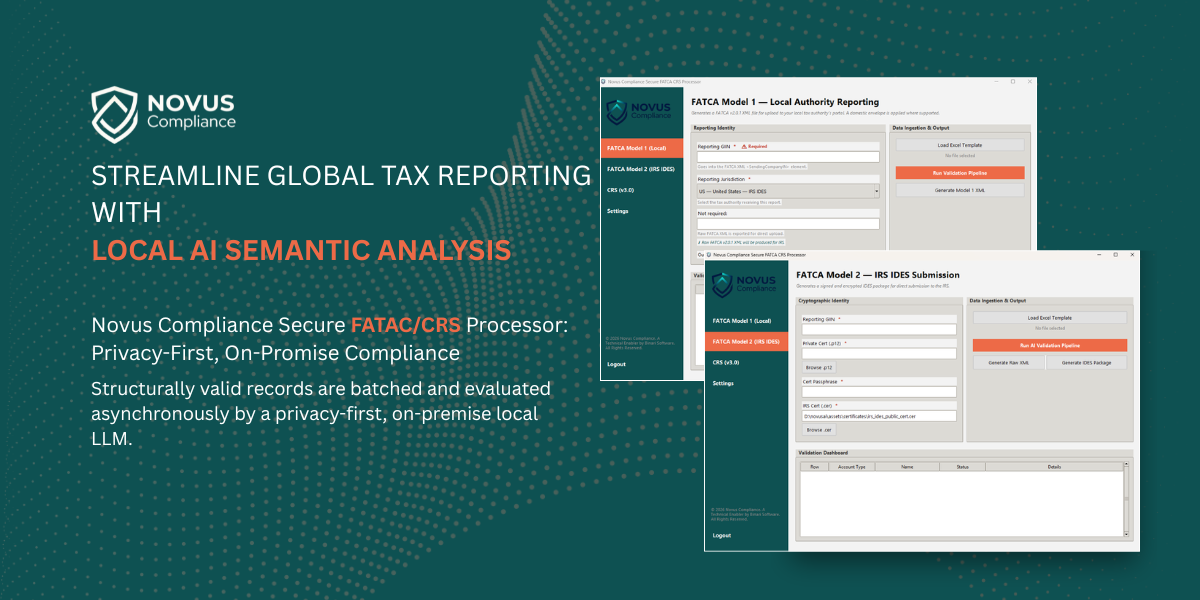
This is why modern family offices and their advisors use dedicated fatca crs reporting software like Novus Compliance. We act as a pure technical enabler. You provide the final classifications for the trust and its controlling persons, and our platform handles the complex parent-child XML nesting, the multi-jurisdictional residency logic, and the final cryptographic security.
By separating the legal advisory from the technical file generation, private wealth managers can eliminate portal rejections, secure their highly sensitive client data, and confidently navigate the complexities of global tax transparency.