
As we move into August 2026, the global tax compliance landscape is entering a critical transitional phase. While most financial institutions (FIs) have successfully filed their 2025 FATCA and CRS reports, the focus has abruptly shifted to the technical challenges of the current reporting year.
Tax authorities are no longer just looking at whether you filed; they are aggressively analyzing how you filed. For tax consultants and FIs worldwide, the remainder of 2026 revolves around two massive technical pivots: surviving the IRS's intensified scrutiny of missing Taxpayer Identification Numbers (TINs) and upgrading legacy systems to handle the new CRS XML Schema v3.0.
Here is what your compliance pipeline must be prepared to handle right now.
1. The IRS TIN Crackdown: End of the Road for Lazy Formatting
One of the biggest headaches for FIs has historically been pre-existing accounts that are missing a valid US TIN. In response, the IRS extended temporary relief for missing TINs through 2027 (via Notice 2024-78). However, this extension is not a free pass—it comes with highly rigid technical conditions.
The IRS has updated its FATCA schema validation rules to strictly monitor how FIs report these missing TINs. You can no longer leave the field blank or use generic placeholders. FIs must now map their missing data to very specific, IRS-mandated dummy codes based on the exact circumstances of the account.
For example, your XML generation logic must dynamically assign:
-
222222222: For pre-existing individual accounts where the only US indicia is a US place of birth. -
444444444: For accounts that have US indicia other than a US place of birth, but valid self-certification has not been obtained despite a change in circumstances. -
666666666: For pre-existing entity accounts held by a passive NFFE with controlling persons lacking self-certification.
If your tax software or filing agent hardcodes a generic 999999999 placeholder across the board, the IRS validation engine will flag your FATCA submission, potentially triggering an audit into your broader KYC and due diligence procedures.
2. The Shift to CRS 3.0: A Complete Architectural Overhaul
While FATCA enforces strict TIN rules, the OECD is demanding a complete structural upgrade. The calendar year 2026 marks the first period where data must be collected and formatted under the new CRS XML Schema v3.0 (with first exchanges happening in 2027).
This is not a minor version bump. The transition to CRS 3.0 is a comprehensive overhaul designed to align traditional reporting with the incoming Crypto-Asset Reporting Framework (CARF).
For technical teams, this means your data mapping architecture must change immediately. The new schema introduces:
-
Expanded Data Fields: New structures for digital payment instruments and hybrid assets.
-
Stricter XSD Validations: The OECD has tightened the XML Schema Definition (XSD) rules. Minor formatting errors that were previously accepted will now result in immediate file rejection.
-
Controlling Person Clarity: Enhanced parent-child XML nodes to clearly define the relationship between Passive NFEs and their controlling persons.
If an FI is still using legacy spreadsheet macros built for CRS 2.0 to generate their 2026 data files, those payloads will fail the structural validation checks when the 2027 submission window opens.
The Solution: Decoupling Advisory from Technical Execution
For global tax consultants and financial institutions, the complexity of these 2026 schema changes highlights a growing problem: tax advisory and XML code generation are two entirely different skill sets. Expecting your tax team to dynamically map IRS TIN logic and debug CRS 3.0 XSD schemas is a recipe for portal rejections.
This is exactly why the industry is shifting toward pure-play technical enablers like Novus Compliance.
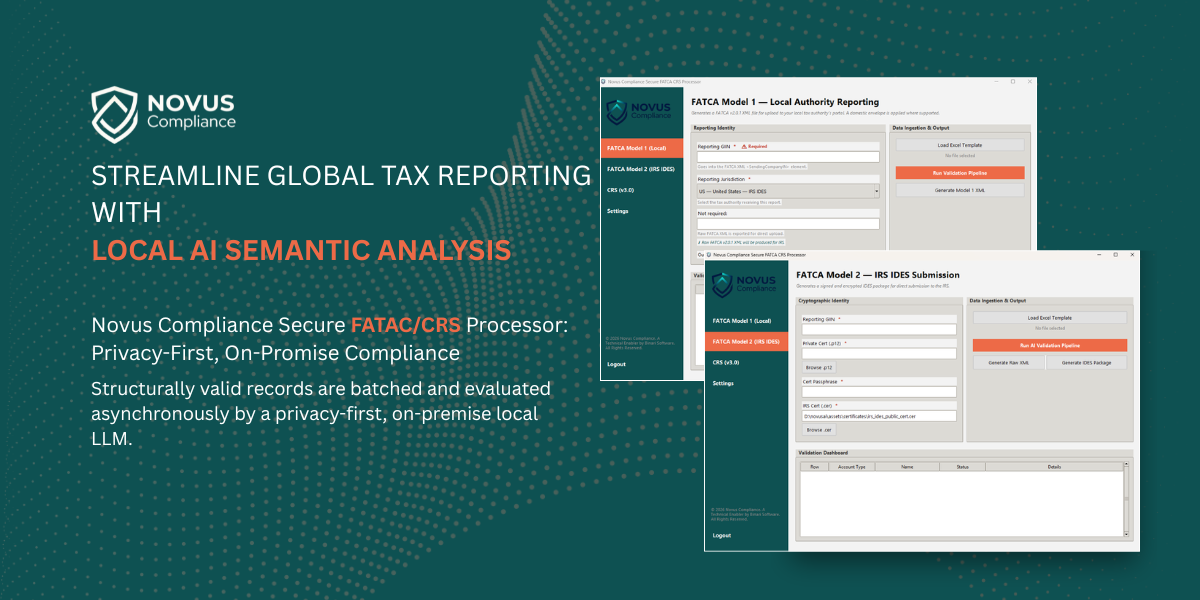
We do not provide tax advice—we provide the technical engine. Consultants and FIs finalize their client classifications, and our platform takes over the execution. We programmatically map your raw operational data into pristine, pre-validated FATCA and CRS 3.0 XML schemas, completely handling the complex TIN code logic.
Furthermore, we wrap the final XML payload in AES-256 encryption and ISR-standard SSL certificates, ensuring your data is cryptographically locked and ready for direct upload to portals like the IRS IDES gateway.
By decoupling the tax advisory from the technical file generation, institutions maintain total control over their compliance decisions while completely eliminating the technical friction of the 2026 schema updates.