
For financial institutions and compliance teams, the technical landscape for global tax reporting is undergoing a massive restructuring. As we move into the 2026 reporting cycles, the IRS and the OECD have drawn a hard line in the sand regarding data structure, validation, and schema compliance.
With the rollout of FATCA XML Schema v2.0.1 and CRS XML Schema v3.0, the challenge is no longer just gathering the right client data. The challenge is ensuring your data payload survives increasingly ruthless automated validation engines.
Here is a technical breakdown of the schema changes and why relying on legacy systems—or worse, manual XML construction—is a critical vulnerability this year.
FATCA XML Schema v2.0.1: Zero Tolerance for Formatting Errors
The IRS has fully transitioned to FATCA XML Schema v2.0.1. The defining characteristic of this update is a shift toward absolute structural alignment and strict syntax enforcement.
-
Hardcoded ISO Enforcement: The new schema outright rejects deviations from international standards. Country codes must strictly adhere to the two-character ISO 3166-1 alpha-2 standard. Currency codes must exactly match the three-character ISO 4217 alpha-3 standard. A single trailing space or lowercase character can now trigger a payload rejection.
-
Structural Alignment: Name and address elements have been overhauled to align with the OECD’s Standard Transmission Format, forcing a unified data shape across both FATCA and CRS pipelines.
-
TIN Validation Reason Codes: Missing U.S. Taxpayer Identification Numbers (TINs) can no longer simply be left blank or filled with generic zeroes without consequence. The schema now requires specific, standardized reason codes explaining the absence of the TIN, directly impacting the XML node structure.
CRS XML Schema v3.0: The Introduction of CARF and Explicit Flags
The OECD’s update to CRS v3.0 (often referred to as CRS 2.0) is fundamentally about expanding the scope of reportable assets and closing implicit reporting loopholes.
-
Integration with CARF (Crypto-Asset Reporting Framework): The schema has been expanded to support the reporting of digital assets. Central Bank Digital Currencies (CBDCs) and Specified Electronic Money Products (SEMPs) are now explicitly mapped within the XML tree, requiring new data nodes for institutions holding digital assets.
-
The Boolean Self-Certification Requirement: Previously, submitting a report implicitly suggested that valid self-certifications were on file. Schema v3.0 introduces mandatory Boolean indicator fields. Institutions must now inject explicit
true/falseflags at the XML node level confirming the existence of valid self-certifications for account holders and controlling persons.
The Bottleneck: Why Manual Generation is a Liability
These updates share a common theme: the margin for technical error is now zero.
When a financial institution attempts to generate these XML files manually or through patched-together legacy software, they face a high probability of XSD (XML Schema Definition) validation failures. A single broken tag, an unescaped ampersand in a client's address, or a mismatched namespace will cause the receiving tax authority's gateway to instantly reject the entire transmission.
Furthermore, data privacy regulations demand that this highly sensitive financial data cannot simply be passed around in raw text files.
The Solution: A Dedicated Technical Enabler
Navigating this doesn't require a compliance officer to become an XML architect; it requires a dedicated technical enabler that sits between the institution's database and the tax authority's gateway.
To guarantee compliance and data security in 2026, financial institutions must utilize systems designed for two highly specific tasks:
-
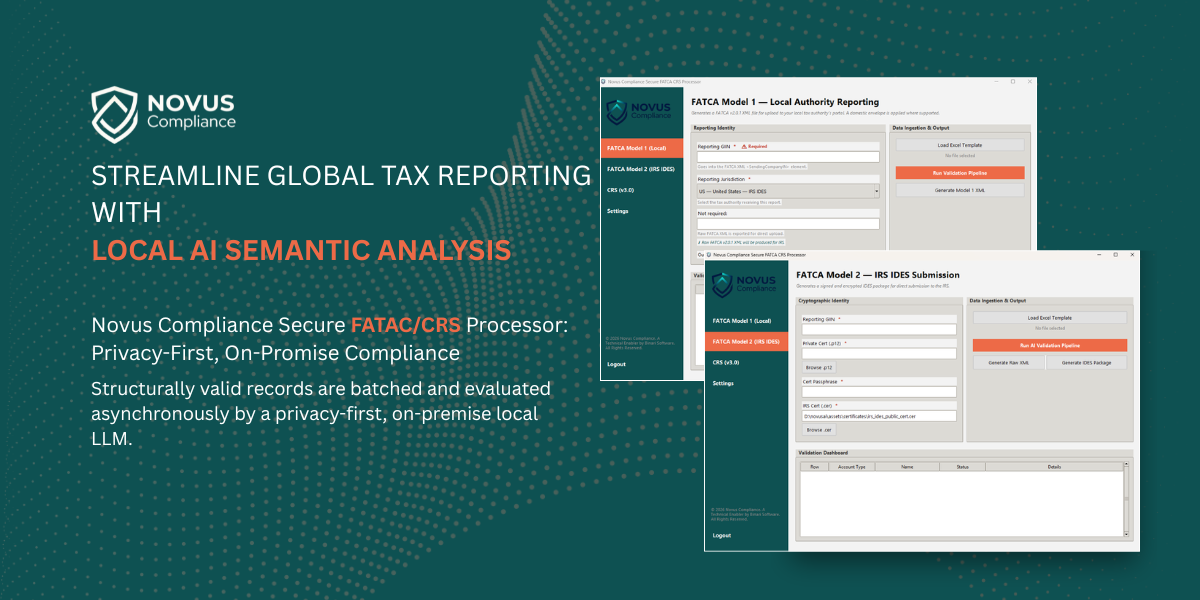
ISR-Standard XML Generation: The system must programmatically ingest raw financial data and map it directly into the exact node structures required by FATCA v2.0.1 and CRS v3.0, ensuring absolute compliance with International Standard Reporting (ISR) formats. Every ISO code, TIN reason code, and Boolean flag must be automatically validated against the schema before the file is ever finalized.
-
Payload Security via SSL Encryption: Generating the file is only half the battle. Because these XML files contain highly sensitive personally identifiable information (PII) and financial data, the generated payload must be immediately secured. The technical enabler must encrypt the finalized XML file using robust SSL certificates, ensuring the data is unreadable to anyone intercepting it during transmission.
Financial institutions do not necessarily need a third party to act as their filing agent. They need a robust technical infrastructure that guarantees the file they upload is structurally flawless and cryptographically secure. As the schemas get stricter, mastering the XML generation pipeline is the only way to ensure uninterrupted global compliance.