

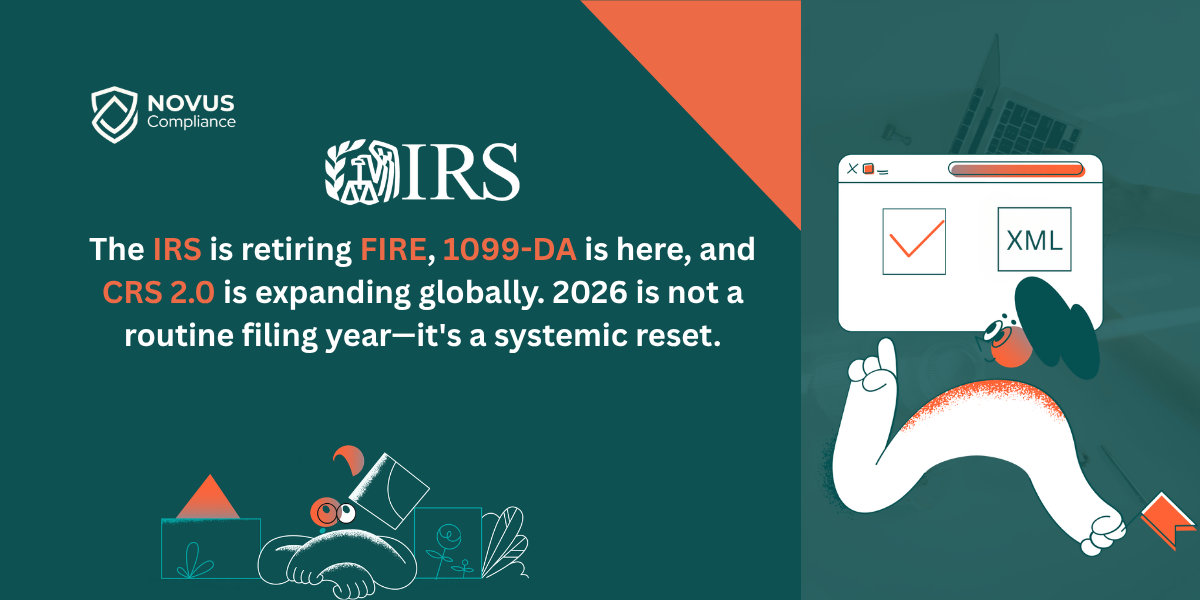
If your institution still treats FATCA, CRS, and 1099 reporting as an annual administrative exercise, 2026 is the year that assumption collapses. Three converging forces—the IRS’s wholesale retirement of its legacy filing infrastructure, the introduction of entirely new information return forms for digital assets, and the global expansion of the Common Reporting Standard to cover crypto and electronic money - have collectively transformed tax reporting from a year-end task into a continuously managed compliance lifecycle. Organisations that fail to adapt will face rejected filings, escalating remediation costs, and heightened scrutiny from tax authorities no longer satisfied with annual submissions alone.
Here is what is changing, why it matters, and how the right technology partner can turn this regulatory pressure into a competitive advantage.
The IRS Is Retiring FIRE: December 2026 Is a Hard Deadline
The backbone of electronic information return filing in the United States for decades—the Filing Information Returns Electronically (FIRE) system—is scheduled for retirement on December 31, 2026. Its replacement, the Information Returns Intake System (IRIS), is not a cosmetic upgrade. It fundamentally changes how filings are validated and transmitted.
Under FIRE, validation largely occurred after submission, meaning errors were flagged after acceptance and required corrective filings. IRIS operates on real-time validation before acceptance. File formats, size limits, and bulk filing processes have all changed. For institutions that have relied on legacy workflows, the transition demands a fundamental re-engineering of the reporting pipeline—not a simple system swap.
The implications are particularly acute for Forms 1042-S and 1099. From tax year 2026 (filed in early 2027), electronic transmission of these forms must use IRIS. Institutions that have not migrated by December 2026 will find themselves locked out of the electronic filing infrastructure entirely.
Form 1099-DA and the $2,000 Threshold: A Double Shock for Payer Operations
Two simultaneous changes are reshaping the 1099 landscape.
First, the reporting threshold is rising. Under the One Big Beautiful Bill Act (OBBBA), the longstanding $600 threshold for certain payments reported on Form 1099-NEC and many 1099-MISC payments has increased to $2,000, effective for payments made after December 31, 2025. For 2026 tax-year filings due in early 2027, businesses that pay an independent contractor $1,800 during the calendar year no longer need to file a 1099-NEC for that payee. While this reduces filing volume for some, it adds complexity: institutions must now determine, on a payee-by-payee basis, which payments fall above or below the new threshold, and the threshold will be adjusted for inflation beginning in 2027.
Second, digital asset reporting has arrived. The introduction of Form 1099-DA for Tax Year 2025 filings (due in 2026) marks the first large-scale reporting of digital asset transactions for many organisations. Initial requirements focus on gross proceeds reporting, but this is explicitly a phased expansion. Cost basis reporting is coming, bringing new data dependencies, reconciliation challenges, and customer communication obligations that most firms are only beginning to address. The revised Form 1099-DA reporting framework also introduces nuanced exemptions—for example, brokers who did not deposit gross proceeds from digital asset sales into a customer’s wallet or account may be exempt from 1099-DA reporting if they obtain a properly completed Form W-9 from another broker.
The Novus Takeaway: These are not isolated form updates. They represent a structural shift in how institutions prepare, validate, and file information returns. Institutions that continue to rely on manual consolidation or outdated spreadsheet workflows will struggle to keep pace with real-time validation requirements and evolving digital asset data models.
The Global Standard Is Expanding: CRS 2.0 and the Crypto Reporting Wave
Internationally, the Common Reporting Standard is undergoing its most significant update since its adoption in 2016. CRS 2.0, which took effect in January 2026, expands the scope of reportable assets to cover digital financial products, strengthens due diligence requirements, and aligns the CRS framework with the emerging digital finance regulatory architecture.
This is not merely a change in what gets reported; it is a change in how compliance is demonstrated. CRS 2.0 emphasises the full scope of CRS regulations—not just the annual filing. Financial institutions must now show end-to-end due diligence, including how they document investor onboarding, transfers, and remediation, particularly whether valid self-certifications are held and supported by the information on file. For fund managers and institutions with complex intermediary structures, this means capturing additional reportable data points across equity and debt interests, including those held through feeders, nominees, or intermediaries.
In parallel, the Crypto-Asset Reporting Framework (CARF) and the EU’s DAC 8 directive have introduced a parallel reporting regime for crypto-asset transactions. While not all fund structures are directly in scope, groups with digital-asset strategies or related entities should assess classification, data sourcing, and controls across both traditional CRS and crypto-asset reporting ahead of implementation from 2026 onwards.
The Global Forum has been actively supporting jurisdictions in implementing the amended CRS, with the first exchanges under the expanded standard scheduled for September 2027. The message to financial institutions is clear: the data foundation for CRS 2.0 compliance must be built now, not when the first reporting deadline arrives.
The Enforcement Paradox: Why Sloppy Compliance Is Riskier Than Ever
An uncomfortable truth is buried in recent enforcement data. A Treasury Inspector General for Tax Administration (TIGTA) audit released in April 2026 revealed that while the IRS’s total costs for FATCA administration have approached nearly $700 million, its enforcement execution remains surprisingly weak. In a specific campaign (Campaign 896) targeting egregious nonfilers, the IRS identified 405 taxpayers who appeared to have blatantly ignored their reporting obligations—a group with aggregate foreign account balances approaching a staggering $6.2 trillion.
Yet, the IRS’s response was shockingly lenient. Of those 405 high-value targets, the IRS examined only 12 by the end of the audit period. The resulting non-filing penalties assessed against this group? A meagre $80,000.
On the surface, this might suggest low enforcement risk. That interpretation would be dangerously wrong.
TIGTA strongly criticised this approach, noting that by failing to penalise the unexamined non-filers in this campaign, the IRS missed out on approximately $3.93 million in initial penalties. More importantly, while the IRS rejected calls for automatic penalties, it agreed to explore incorporating Form 1099 data bearing a FATCA indicator into its matching process.
In other words, the enforcement apparatus is not absent—it is under construction. The IRS is building the data infrastructure and audit algorithms that will enable far more systematic enforcement in the years ahead, explicitly connecting domestic information reporting with international tax compliance. Institutions that treat the current low-penalty environment as a signal that compliance is optional are accumulating risk that will materialise as enforcement matures.
Why Novus Compliance Is Built for This Moment
The 2026 reporting cycle is not a routine filing adjustment. It is a systemic shift toward real-time validation, structured data, and lifecycle accountability across jurisdictions. Navigating it requires more than software—it requires a partner who understands the technical minutiae of schema changes, the operational realities of multi-jurisdiction filing, and the security imperatives of handling sensitive financial data.
Novus Compliance was engineered for exactly this environment.
Schema-Perfect Reporting, Without the Engineering Burden
The transition to FATCA XML Schema v2.0.1 and CRS XML Schema v3.0 introduces unforgiving structural changes. From shared common namespaces to highly specific routing rules governing when a Tax Identification Number versus an Identification Number is legally permissible, a single misplaced tag—such as omitting a Controlling Person block for a CRS101 Passive NFE or rendering an address sequence incorrectly—will result in immediate payload rejection from the IRS IDES gateway or local tax authorities.
Our engineering team has spent months mapping every business rule and edge case into the Novus Compliance engine. We automate the heavy lifting of data translation, converting simple Excel uploads into flawless, encrypted XML payloads that perfectly align with the new IRS and OECD schema mandates. Your team focuses on data quality; we handle the schema complexity.
The Third-Party Transmitter Advantage
Beyond software, Novus Compliance operates as an authorised Third-Party Transmitter. For clients on our Professional Tier, this represents significant operational and cost savings. Instead of your institution navigating the complex cryptographic requirements to purchase, install, and manage an IRS-approved digital certificate, Novus Compliance signs, encrypts, and transmits the AES-256-secured packages on your behalf. We interface directly with the International Data Exchange Service (IDES) and other regional gateways, ensuring your payloads are packaged, encrypted, and transmitted securely according to the latest mandates.
This is not a peripheral service. For institutions without dedicated in-house cryptography teams, the Third-Party Transmitter model eliminates a critical operational bottleneck while maintaining full auditability and compliance.
Security and Auditability by Design
When dealing with sensitive financial and account holder data, security cannot be an afterthought. Every piece of data processed through Novus Compliance is protected by industry-standard encryption, both at rest and in transit. We employ strict access controls and isolated data processing environments—your information is never commingled with other clients. And enterprise-grade governance is built into the platform, maintaining a transparent, step-by-step audit trail of your reporting lifecycle so your compliance officers have complete visibility into how data was processed and when it was filed.
Built to Scale With Regulatory Change
The regulatory landscape is not stabilising; it is accelerating. CRS 2.0, CARF, DAC 8, IRIS, 1099-DA—each of these represents a distinct compliance stream with its own data requirements, validation rules, and filing timelines. Novus Compliance is architected to absorb this complexity. Our platform updates automatically when the IRS or OECD revises reporting guidelines, and our pricing scales with your actual filing volume rather than locking you into rigid, overpriced contracts.
Your Action Plan for the 2026 Reporting Season
-
Audit your IRIS readiness. If you haven't mapped your 1042-S and 1099 filing workflows to the IRIS platform, December 2026 is closer than it appears. Real-time validation before acceptance means errors that were previously correctable post-filing may now block submission entirely.
-
Review your 1099 threshold logic. The $2,000 threshold changes which payees require forms. Ensure your payment systems and reporting engines are calibrated to the new rules—and monitor for the inflation adjustment that takes effect in 2027.
-
Assess your digital asset reporting exposure. If your organisation processes any digital asset transactions, you now must file Form 1099-DA. Begin mapping the data dependencies for gross proceeds reporting and prepare for cost basis reporting in future cycles.
-
Stress-test your CRS due diligence documentation. CRS 2.0 is not just about what you report; it is about what you can prove. Verify that your self-certification records are complete, current, and supported by the information on file—especially for entities held through intermediaries or feeders.
-
Partner with a transmitter who understands the stakes. The technical, cryptographic, and regulatory complexity of the 2026 reporting cycle is not something to navigate alone. Novus Compliance combines schema-perfect XML generation, authorised Third-Party Transmitter capabilities, bank-grade encryption, and transparent, scalable pricing into a single platform built for the modern compliance era.
Ready to Simplify Your 2026 Tax Reporting?
Don’t let IRIS, 1099-DA, or CRS 2.0 catch your team off guard. Explore the Novus Compliance platform or speak directly with our team.
Solutions
Get Started
Resources
Or book a technical scoping call directly: