
If your organization is a foreign entity making reportable payments to U.S. contractors or vendors, you face a formidable administrative hurdle: standard IRS electronic filing systems assume your compliance officers possess U.S. identity credentials. For teams based entirely outside the United States, that assumption brings standard e-filing to a halt.
With the retirement of legacy intake channels like the Filing Information Returns Electronically (FIRE) system, the IRS now routes information returns through modernized infrastructure: the Information Returns Intake System (IRIS) and the International Data Exchange Service (IDES). While domestic businesses authenticate through IRIS using U.S. tax credentials, foreign entities without domestic personnel require an alternative gateway. The IRS provides this specific pathway through the Foreign Filer Transmitter Control Code (TCC) Registration System.
Understanding how this architecture works—and where entity-level requirements intersect with individual authentication—is essential to maintaining compliance and avoiding failure-to-file penalties.
The Foreign Filer TCC Framework Explained
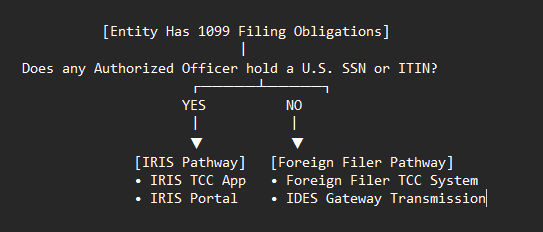
The IRS established the Foreign Filer TCC Registration System exclusively for organizations whose authorized users (individual officers and filing agents) lack a U.S. Social Security Number (SSN) or Individual Taxpayer Identification Number (ITIN).
Because standard IRIS portal authentication requires identity verification through platforms configured for U.S. identification (requiring at least two Responsible Officials with a domestic TIN), foreign corporate leaders are locked out of direct IRIS registration.
Eligibility for the Foreign Filer system carries an explicit boundary:
-
Eligible: Foreign entities whose authorized individual representatives have no SSN or ITIN.
-
Prohibited: Any entity where at least one authorized user possesses an SSN or ITIN; such entities are required by regulation to apply directly through the IRIS Application for TCC and transmit through IRIS.
Clarifying the TIN Requirement: Authorized Users vs. The Business Entity
A common point of confusion among international controllers is whether foreign filers require a U.S. tax identity at all. The distinction lies between individual users and the business entity itself:
-
Authorized Users (Individuals): You do not need a U.S. SSN or ITIN to complete the Foreign Filer registration. Foreign identification is accepted to establish your sign-in identity via Login.gov or ID.me.
-
The Business Entity (The Payer): The reporting entity must possess a valid 9-digit IRS-issued Employer Identification Number (EIN). Even when transmitting via IDES, the IRS 1099 schema strictly enforces the Payer Taxpayer Identification Number field.
If your non-U.S. company does not yet possess an EIN, you cannot use the standard domestic online assistant. Instead, you must submit IRS Form SS-4 (Application for Employer Identification Number) via the IRS International Telephone Service (+1-267-941-1099) for immediate verbal assignment, or by fax (+1-304-707-9471).
The Four Sequential Credentials
Navigating the Foreign Filer architecture requires obtaining four discrete credentials in strict sequence:

-
Foreign Filer ID (6 characters): An alphanumeric account identifier generated immediately upon initiating your online account. It is used strictly for portal access and account administration, not for information return transmission.
-
TCC GIIN (19 characters): A system-generated Global Intermediary Identification Number issued once the IRS vets and approves your initial registration. This identifier supports the backend link to the International Data Exchange Service (IDES) and is required to request your transmission code. (Note: Unlike FATCA GIINs, this number is purely operational and is not published on the public IRS Foreign Financial Institution list).
-
Foreign Filer TCC (5 characters): The formal Transmitter Control Code issued upon entering your validated entity EIN after TCC GIIN approval. This code authorizes the electronic batch transmission of information returns exclusively through IDES and cannot be utilized for other IRS filing portals.
-
IDES Enrollment: The final onboarding step where the Responsible Officer (acting as the IDES Administrator) configures transmission access. This step requires procuring an approved digital certificate from an accredited Certificate Authority to sign and encrypt all outward XML payloads.
The End-to-End Registration Workflow
Following IRS Publication 6170, the administrative progression moves through six distinct milestones:
-
Step 1: Identity Profile Setup: Create a Login.gov or ID.me profile using foreign credentials. Ensure the email address matches the email designated for the entity’s Responsible Officer (RO).
-
Step 2: Account Creation & ID Assignment: Access the Foreign Filer TCC portal on IRS.gov, accept system terms, and obtain your 6-character Foreign Filer ID.
-
Step 3: Registration Submission: Complete legal entity details, primary mailing address, Responsible Officer information, and optional Points of Contact (up to five). Submit the application under official certification.
-
Step 4: Application Review & TCC GIIN Issuance: The IRS validates registration details. Upon approval, your status changes to Approved, and your 19-character TCC GIIN appears on your home dashboard.
-
Step 5: TCC Generation via EIN: Select "Request TCC," enter your 9-digit corporate EIN (
nn-nnnnnnn), and generate your 5-character TCC. -
Step 6: IDES Synchronization & Enrollment: The IRS mandates a 3 to 6 week processing interval between TCC issuance and IDES enrollment to ensure internal databases fully synchronize. Once synced, complete administrative enrollment within IDES using your digital certificate.
Filing Deadlines for Tax Year 2026 / 2027
Filing schedules require meticulous planning, particularly when taking into account the administrative lead time required to secure transmission privileges:
-
Form 1099-NEC (Nonemployee Compensation):
-
Recipient Copy: February 1, 2027
-
IRS Electronic Transmission: February 1, 2027
(Because January 31, 2027, falls on a Sunday, the statutory deadline moves to the next business day, Monday, February 1).
-
-
Form 1042-S (Foreign Person's U.S. Source Income):
-
Recipient & IRS Filing: March 15, 2027
-
-
Form 1099-MISC (Miscellaneous Information):
-
Recipient Copy: February 1, 2027
-
IRS Electronic Transmission: March 31, 2027
-
Given that initial application reviews can take up to 45 business days—compounded by the mandatory 3-to-6-week IDES synchronization hold—establishing your own independent filing pipeline can take 3 to 4 months end-to-end. Entities must begin setup during the third quarter of the calendar year to guarantee readiness for January reporting windows.
How Novus Compliance Accelerates Foreign Entity Filing
Navigating the multi-month credentialing runway while managing day-to-day accounting operations is often impractical for international enterprises. Novus Compliance acts as a dedicated global tax compliance engine, bridging foreign enterprise data directly with IRS ingestion standards.

-
Structured Data Intake: Leverage our verified intake templates, mapped 1:1 against verbatim IRS schema specifications (including name splits, country indicators, TIN controls, and state withholding parameters).
-
Pre-Transmission Validation: Our ingestion pipeline checks formatting logic, detects mismatches between corporate names and TINs, and flags schema discrepancies before data is transmitted.
-
Encrypted Gateway Routing: Novus Compliance builds and validates the structured XML payloads, ensuring clean electronic transmission through authorized channels without requiring your internal team to configure cryptographic certificates or undergo IDES credentialing delays.
-
Audit-Ready Confirmation: Every file transmission produces a formal, timestamped IRS processing acknowledgment for corporate audit trails.
Frequently Asked Questions
Q. Can our foreign entity file 1099s if our leadership holds no U.S. SSN or ITIN?
A: Yes. The IRS Foreign Filer TCC Registration System allows entities whose personnel lack U.S. taxpayer identification to register and transmit returns via IDES without an SSN or ITIN.
Q: Can a single Foreign Filer TCC cover multiple subsidiaries?
A: Yes. Under IRS guidance, if an authorized administrator manages filing operations across related entities, one approved TCC GIIN and Foreign Filer TCC can be used to transmit returns on behalf of multiple related corporate structures.
Q. What forms are supported via IDES for Foreign Filers?
A: The Foreign Filer pipeline supports electronic transmission of Form 1042-S, applicable Forms 1099 (including 1099-NEC and 1099-MISC), and associated annual information returns.
Q. What happens if our entity name does not match IRS records?
A: If the legal name entered during registration deviates from the name tied to the EIN in IRS master files, the system will trigger a validation block during the TCC request phase. The legal name must be entered identically to Line 1 of your Form SS-4.
Related resources
IDES 1099 Filing for Foreign Filers — full technical walkthrough
IRIS 1099 Filing Guide — TCC registration, XML schema, field reference
Free 1099 IRIS Excel Templates — with test data