
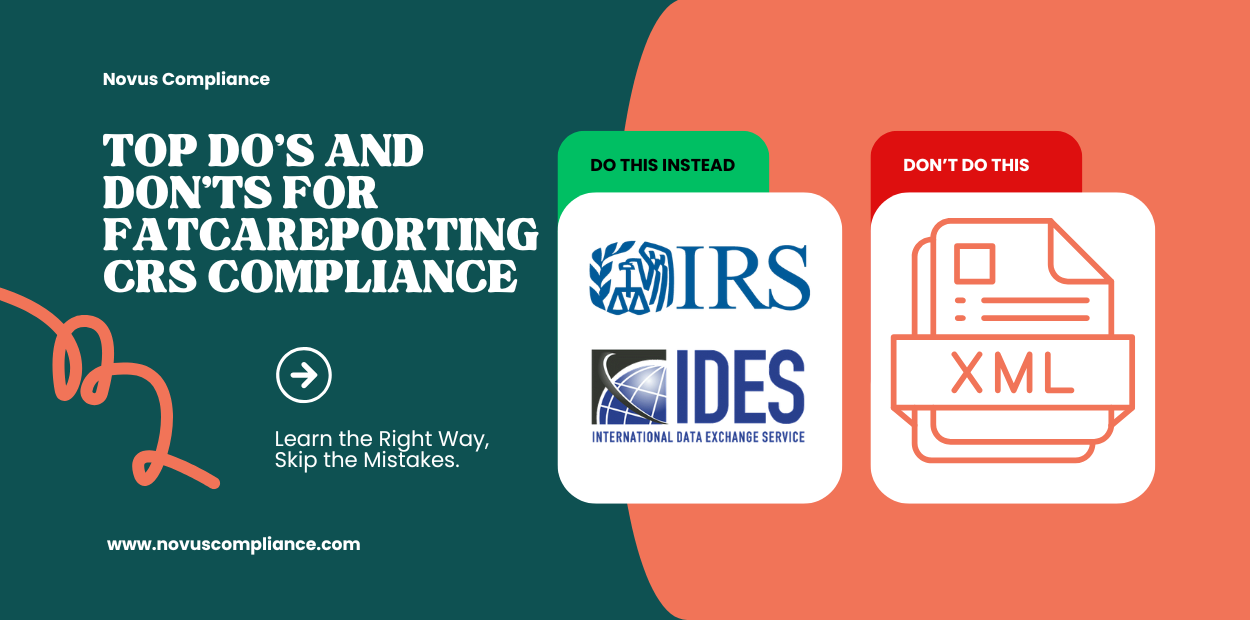
The Definitive Dos and Don'ts of FATCA and CRS Reporting
Navigating the complexities of the Foreign Account Tax Compliance Act (FATCA) and the Common Reporting Standard (CRS) requires a flawless blend of legal understanding and rigorous technical execution.
For financial institutions and their compliance teams, a single misstep—whether misclassifying an entity or failing a cryptographic padding check—can result in severe gateway rejections or the revocation of a Global Intermediary Identification Number (GIIN).
To ensure your mid-year and year-end reporting cycles are frictionless, here are the critical technical and administrative Dos and Don'ts for FATCA and CRS compliance.
The "Dos" of Technical Compliance
1. DO separate legal classification from technical execution. The biggest mistake entities make is assuming their reporting software also provides tax advice. Determining your exact legal bucket (e.g., Active NFFE vs. Reporting Model 1 FFI) requires an international tax advisor. Once your classification is locked in, you need a dedicated technical engine to translate that raw data into perfectly formatted transmission files.
2. DO enforce strict cryptographic standards. The IRS IDES gateway does not forgive encryption errors. When packaging your XML payloads, you must strictly utilize AES-256 encryption in CBC mode. Ensure that your infrastructure precisely concatenates the 32-byte AES key and the 16-byte Initialization Vector (IV) into exactly 48 bytes before encrypting it with the IRS Public Key. Failing this results in the dreaded "Failed Decompression" or NDP error.
3. DO monitor your Responsible Officer (RO) deadlines. While your technical team handles the data transmission, your designated Responsible Officer must manually log into the IRS portal via Login.gov or ID.me to complete administrative certifications. Software cannot do this for you. Missing these manual certifications can result in immediate GIIN revocation.
4. DO keep up with XML Schema updates. Tax authorities frequently deprecate old reporting formats. For example, ensuring your system is fully aligned with transitions to newer schemas (like FATCA XML v2.0.1) is mandatory. Your XML generator must be dynamically maintained to avoid instantaneous schema validation failures upon upload.
The "Don'ts" of Technical Compliance
1. DON'T use standard, off-the-shelf ZIP tools. You cannot simply right-click and "compress" your XML files to send to the IRS. The IDES gateway requires a highly specific nested ZIP architecture. If your compression utility leaves internal timestamp prefixes on the payload files, the gateway will instantly reject your submission with an RC012 Timestamp/Naming Error.
2. DON'T base64 encode your AES payloads. When configuring your OpenSSL or cryptographic libraries, the IRS mandates an Encoding: None parameter. Passing your encrypted payload through base64 encoding before packaging it into the final ZIP will cause the receiving server to misread the file geometry, leading to immediate transmission failure.
3. DON'T use an outdated IRS Public Key. The IRS periodically rotates its cryptographic keys (such as the major update in October 2025). If your system attempts to encrypt the sender key using an expired .cer file, the gateway will be physically unable to unlock your transmission. Always verify you are pulling the latest public key from the official IDES certificate authority list.
4. DON'T test on the live production gateway first. Never push unverified structural updates directly to the IRS production servers. Always run your newly packaged XML through the IDES Test Environment first. Achieving an RC001 (Successful Upload) status in the test portal is the only way to guarantee your XML geometry and AES encryption are completely structurally sound before the hard deadlines hit.
Secure Your Reporting Pipeline
Are your FATCA and CRS transmissions failing at the IDES gateway due to cryptographic padding errors or XML schema mismatches?
At Novus Compliance, we provide the ultimate technical bridge. We do not provide tax advice; we provide flawless execution. Our engine automates the generation of ISR-standard XML, applies the required payload encryption, digitally signs the files, and constructs the exact nested ZIP architecture needed to bypass gateway errors and achieve an RC001 success rate.
Contact Novus Compliance today to secure your compliance infrastructure.